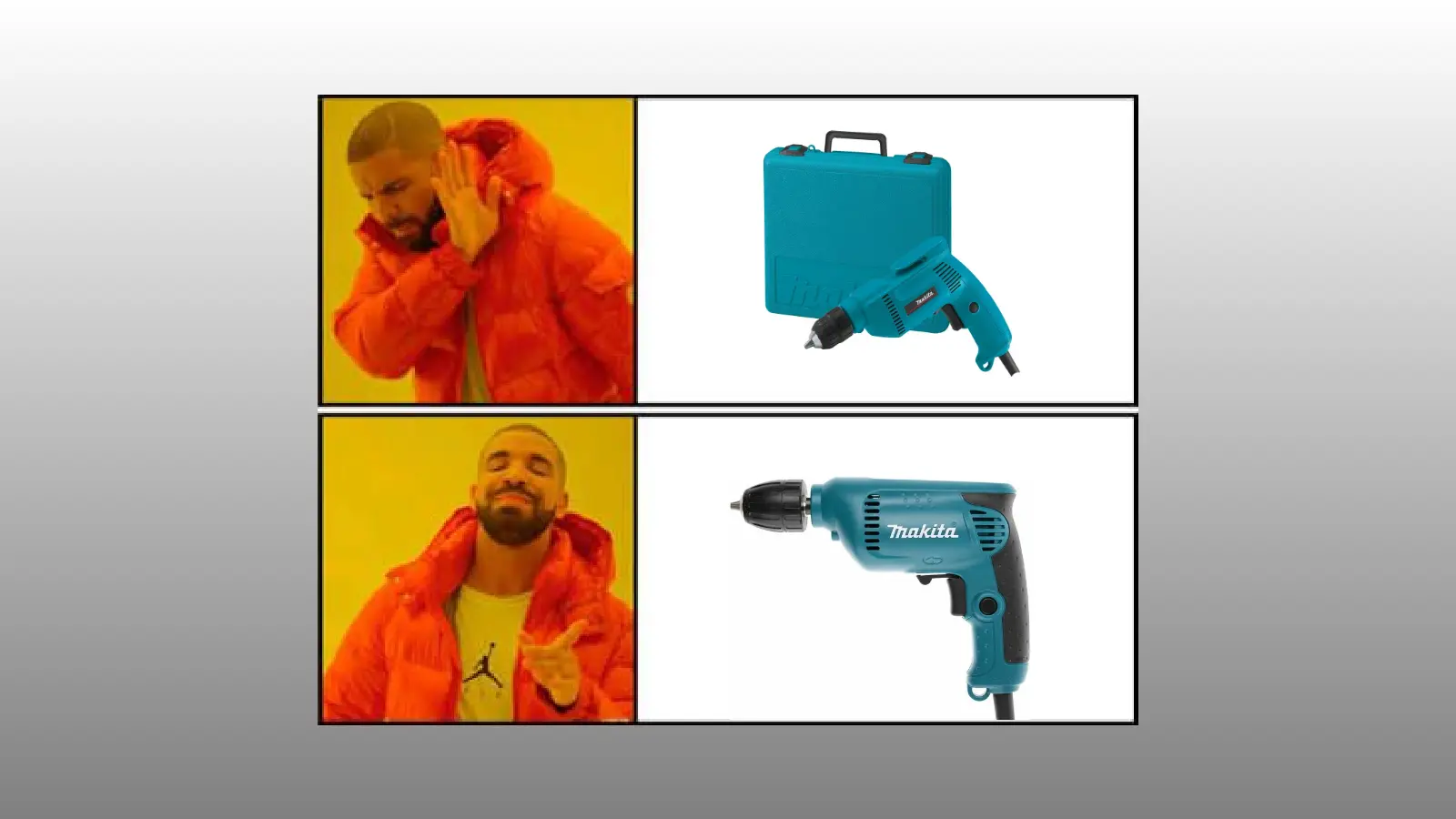
We’ve written a lot about drills on this blog. We recommended the Makita 6408K for years, and just recently switched our recommendation to the Makita 6413. Both are excellent drills. But the more we’ve thought about it, the more we’ve come back to a simpler question:
Why are we strapping a construction tool to a massage wheel at all?
Drills Are Overkill — and a Little Scary
Think about what a drill is actually built for: sinking screws into framing lumber, boring through joists, mixing paint. Even the mildest corded drill carries torque far beyond anything the wheel will ever ask of it. The wheel is a light, free-spinning load — it needs steady RPM and almost no muscle.
And there’s an honest point that doesn’t get said enough: a legitimate power tool can be genuinely intimidating to operate around your member. It’s heavy, it roars, and it has power reserves you’ll never use. Plenty of men have told us the drill was the part of powered training they never fully relaxed with — and tension is the enemy of a good session.
The Right-Sized Tool: a Cordless Power Screwdriver
The emerging better option is a cordless power screwdriver — the pistol-grip kind sold for household furniture assembly. The unit we’ve been testing runs about $25 on Amazon (here’s the exact listing — posted purely to be helpful; these listings come and go, and we won’t be maintaining the link if it dies), and it turns out to be almost perfectly matched to what the wheel actually needs:
- Around 2,000 RPM at top speed — more than enough range for training, with a trigger you can feather well below that.
- Modest torque (about 3.5 N·m) — a fraction of a real drill’s, and still plenty to get the wheel spinning and keep it there.
- No electric brake. Release the trigger and the wheel coasts down gently, exactly what we want. (If you’re new here: electric brakes are the number one thing to avoid.)
- Light and quiet. It weighs a fraction of a corded drill, hums instead of roars, and charges over USB — no cord to manage mid-session.
- Cheap. At ~$25, it costs half of the Makita 6413 and a quarter of what the 6408K goes for these days.
Less weight means less arm fatigue. Less noise means easier relaxation. Less intimidation means you actually train. The spec sheet loses to a real drill in every category a contractor cares about — and wins in every category we care about.
Which One Should You Buy?
Here’s our honest caveat: Amazon and AliExpress are flooded with cheap powered screwdrivers, and we cannot review them all. The ~$25, 3.6V pistol-grip unit described above is the only one we can personally vouch for right now.
If you decide to try a different one, use these rules:
- Match the size class. You want a full pistol-grip unit similar in size to a small drill. There are dozens of smaller screwdrivers out there that are really made for disassembling toys and small electronics — too weak and too awkward for the wheel. Skip them.
- It must have a 1/4” hex chuck. That’s the standard bit socket on this class of tool, and it’s what fits our magnetic nut driver. No 1/4” hex, no wheel.
- No electric brake. Same rule as always. If the listing brags about instant stopping, pass.
- Variable speed trigger. You want to feather it low, not toggle between off and full blast.
Where This Leaves the Drills
If you already own a Makita — the 6408K or the 6413 — there’s nothing wrong with it. They remain great, proven options, and the 6413 is still the drill we’d pick if you want a traditional corded drill. This isn’t a recall; it’s a rethink. For someone buying their first powered setup today, the screwdriver is cheaper, lighter, quieter, and far less nerve-wracking. That’s hard to argue with.
And if you’d rather skip the hardware-store detour entirely: that’s exactly why the Pulse exists. Self-contained, USB-C rechargeable, purpose-built — no drill, no screwdriver, no adapters. It’s coming soon, and until it arrives, a $25 power screwdriver is the easiest on-ramp to powered training we’ve found.