This post is part of the “Vive” side of VascuVive. Vivere means “to live” in Latin — and this half of our mission goes beyond vascular training and PE. It covers the things quietly shaping your health: the environment you live in, the food you eat, and the substances you’re told are safe. If something is undermining your vitality, we think you deserve to know about it.
Your ability to attract a mate, sexually perform, and start a family drives everyday decisions far more than most people realize. We don’t often stop to think about it, but much of what we do on a day-to-day basis — how we eat, how we exercise, how we present ourselves — is unconsciously oriented toward improving these areas of our lives.
So when something quietly undermines reproductive health during the most critical years of development, it deserves serious attention. Especially when millions of teenagers are being prescribed it for acne.
What is Isotretinoin?
Isotretinoin is a vitamin A derivative (retinoid) most commonly known by its original brand name, Accutane. It’s prescribed for severe cystic acne and is considered a last-resort treatment when other options have failed.
It works by shrinking the sebaceous (oil) glands and dramatically reducing oil production. The results for acne can be impressive. But the systemic effects of flooding a developing body with a powerful retinoid go far beyond the skin.
Isotretinoin is already well known for causing birth defects when taken by pregnant women — that’s why female patients are required to use two forms of contraception and take monthly pregnancy tests. But the conversation around what it does to male reproductive health has been far quieter.
What the Research Shows
A 2021 review published in Experimental and Therapeutic Medicine examined isotretinoin’s teratogenic effects on both males and females. Here’s what they found in animal models treated with isotretinoin:
“The results showed that isotretinoin did not induce toxicity in males, but it did produce a decrease in the reproductive organs in weight and also in Sertoli and Leydig cell number. A decreased testosterone level was also identified.”
Let’s break that down:
- Decreased reproductive organ weight — the organs physically shrank
- Decreased Sertoli cell number — Sertoli cells are essential for sperm production and are sometimes called “nurse cells” because they support developing sperm
- Decreased Leydig cell number — Leydig cells produce testosterone, the primary male sex hormone
- Decreased testosterone levels — the downstream consequence of fewer Leydig cells
Perhaps the most telling part of the paper is this:
“The studies regarding the teratogenic effect of isotretinoin on reproductive males are still limited due to the unethical nature of these human studies; thus, further investigations should be performed.”
Read that again. They’re acknowledging that more research is needed, but they can’t ethically do it to humans because the harm is well-established enough. And yet, this drug is still prescribed to teenagers every single day.
FAERS Adverse Event Reports
The FDA’s Adverse Event Reporting System (FAERS) tells a story that aligns with the research. A citizen petition filed with the FDA compiled reported sexual side effects of isotretinoin, and the numbers are alarming.
Here is the complete table of reported reactions involving isotretinoin, sourced from FAERS:
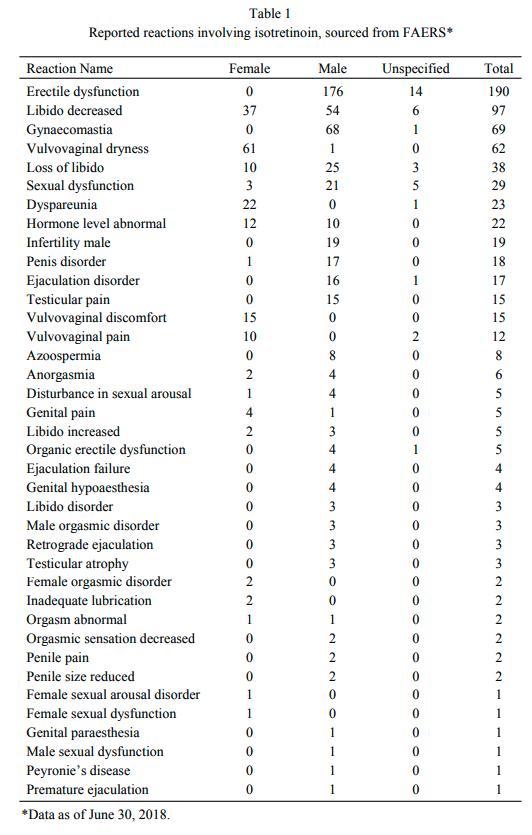
The top reported reactions in males include:
- 176 reports of erectile dysfunction
- 54 reports of decreased libido
- 25 reports of loss of libido
- 19 reports of male infertility
- 17 reports of penis disorder
- 15 reports of testicular pain
- 8 reports of azoospermia (zero sperm count)
- 3 reports of testicular atrophy
- 2 reports of penile size reduced
- 1 report of Peyronie’s disease
And the full list includes ejaculation disorders, orgasm abnormalities, genital pain, and more.
The Age 12-17 Data
What makes this even more disturbing is that within the 12 to 17 age group, isotretinoin was the most reported drug in the FAERS database for the following reactions:
- 31 reports (32%) of erectile dysfunction
- 11 reports (27.5%) of decreased libido
- 5 reports (38.5%) of vulvovaginal dryness
- 6 reports (19.4%) of testicular pain
- 1 report (100%) of organic erectile dysfunction
- 3 reports (75%) of retrograde ejaculation
These are children and teenagers. Their bodies are still developing. And the drug most associated with these sexual side effects in their age group is one prescribed for acne.
A Personal Note
I’m an Accutane survivor. I was prescribed it as a teenager, like millions of others.
For several years afterward, I dealt with a dull but sometimes intense pain in my right testicle. I had attributed it to being kicked in the bathroom by a bully back in 5th grade. It seemed like a reasonable enough explanation, so I never questioned it further.
But after I started increasing my zinc supplementation and deliberately decreasing my vitamin A intake from both foods and supplements, things started to change. The pain improved. And the size of my testicles increased in a way that felt healthy and natural.
I can’t prove that Accutane caused my issues. But the timeline fits. The mechanism fits. And the improvement after addressing vitamin A and zinc status fits too.
Connecting the Dots
This is part of a larger pattern we talk about at VascuVive. Reproductive health is vascular health. The same blood vessels, the same endothelial function, the same hormonal environment that supports erectile quality also supports testicular function, sperm production, and overall sexual vitality.
When you flood the system with a synthetic retinoid that shrinks reproductive organs and lowers testosterone in animal models — and when thousands of adverse event reports confirm sexual dysfunction in humans — it’s worth asking whether the tradeoff of clear skin is really worth it.
Especially when it’s happening to 13-year-olds who have no idea what they’re agreeing to.
If you’ve taken isotretinoin and are dealing with any of these issues, know that the body has a remarkable capacity to heal when you remove the insult and give it what it needs. Start with the basics: reduce vitamin A and D intake from supplements and fortified foods, support your mineral status (especially zinc and magnesium), and give your vascular system the consistent stimulus it needs to rebuild.
That’s what we’re here for.